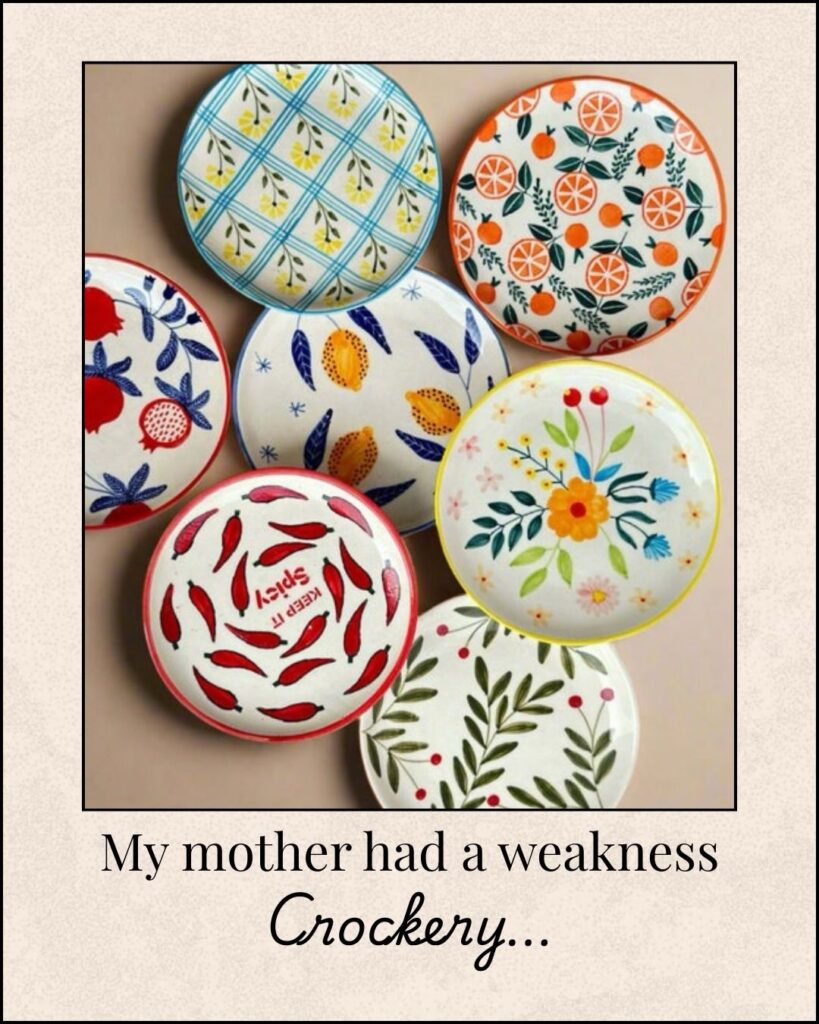
My mother has a serious weakness for crockery.
Not the kind that comes in matching sets but the kind that sneaks into suitcases from everywhere she travelled. London, Dubai, Kashmir, Singapore. If a city had an airport, a market, or a vaguely interesting shop, chances were a plate or cup was coming home. Our crockery cabinet was always full of stories. Each plate holding a memory, each cup carrying a journey.
What stayed with me wasn’t just what she bought but how she cared for it.
Despite having help at home, she washed every piece herself. Slowly. Carefully. Almost ceremonially. She knew which ones needed a gentler touch, which sponge was too harsh, how much pressure was just right. These weren’t chores to be delegated. They were memories she chose to nurture with her own hands.
She used her artistic crockery too. Not recklessly, but without fear. Beautiful things, she believed, were meant to be part of everyday life not locked away for guests who may or may not come.
I adored crockery as well. I would admire it, long to buy it but mostly walk away. My fear wasn’t the price; it was maintenance. What if it broke? What if the help wasn’t careful enough? So I chose basic plates. Safe cups. Things that wouldn’t hurt if they chipped.
There was just one artistic piece I had bought. And every time I used it, I would remind my house help half joking, half serious “Handle it carefully… or I’ll send you to Sri Lanka to buy the same one.” We laughed, but the anxiety was real.
That’s when the real difference between us struck me. Do we avoid what’s beautiful because it might break? Do we dilute joy in the name of safety?
Her crockery lasted decades not because it was hidden away, but because it was nurtured. Loved. Used with intention. And maybe this isn’t just about plates and cups. Maybe it’s about choosing happiness that requires effort. About allowing ourselves beautiful things and accepting the responsibility that comes with them. Because joy, like delicate crockery, doesn’t survive avoidance it survives care.
My mother didn’t. She believed that if something made you happy, it deserved care even if that care took effort. Even if it meant slowing down. Even if it meant doing it yourself.
But does it? What she taught me without ever saying it out loud is that care creates longevity, not avoidance. That when you value something deeply, you don’t hide it away; you show up for it. You take responsibility for it. You invest time, not fear.
Her crockery survived decades not because it was kept out of reach, but because it was held with intention. Maybe this isn’t just about plates and cups. Maybe it’s about how we treat relationships, passions, even ourselves.
Do we avoid what’s beautiful because it might break? Or do we choose to handle it ourselves, knowing that love always carries the risk of loss? My mother chose the latter. And her crockery still intact, still elegant stands as proof that when something matters, you don’t simplify your life around it. You rise to meet it.
She lived believing that beautiful things are meant to be lived with, not protected from life. I live believing that protecting things from damage somehow preserves them. Her cabinet still stands. Quiet. Elegant. Full of stories.
And every time I look at it, I’m reminded: what makes you happy is worth nurturing even if it might break. If something makes you happy, it deserves more than admiration; it deserves your care.